11/13/2011

Topkapi Palace, Istanbul


Jerry and I made another early start when we went to photograph the Topkapi Palace, but the complex was already crowded with sight-seers when we arrived. Jerry paused outside the "Gate of Salutations", to video the crowds. The inscription above the gate reads, "There is no God but Allah, and Mohammed is his prophet."

 
 The walls of the harem, guarding the warren of rooms and 
corridors that make up this complex.

Topkapi Palace covers such a vast area that it takes most of a day to really do it justice. This was the home of the Ottoman sultans for nearly 400 years, and was built by Mehmet II, on the site where the Byzantium Emperors had ruled since Roman times. Topkapi doesn't fit into most people's idea of a palace, as there is no one grand architectural edifice, but rather a collection of small buildings, surrounded by gardens and walkways.


An example of the intricate tiling in the harem


Jerry photographing some detail underneath an imposing 
entrance to a section of the harem


Even the pathways are beautifully designed


We saw many examples of exquisite doors, inlaid with mother of pearl


Jerry taking photos in the "Courtyard of the Queen Mother", 
a central courtyard where members of the royal household could meet.


One of the stained glass window in the royal princes suite.


We had lunch at the Topkapi restaurant, with a magnificent view overlooking the Bosphorus. Although I am sure that the view today is vastly different from the one that the sultans saw.


Photographed out, we finally left Topkapi and walked down the hill to the Bosphorus, stopping to look at the Sirkeci Railway Station, the final stop of the Orient Express.


11/03/2011

Photographing Istanbul (Day 2)


 Cruise ships visiting Istanbul

Our first full day of photography was spent capturing some of the iconic sights of Istanbul, beginning with the Aya Sofya (Hagia Sophia). Although we made an early start, we still had to wait in line, due to the influx of huge numbers of cruise-ship passengers into the city. Finally inside, we were able to take innumerable photographs of this magnificent building. The sheer size of this Byzantine masterpiece is breathtaking, especially when one considers that it was built nearly 1,500 years ago, without the aid of any type of machinery.


While we waited to go into the Aya Sofia, we took photos of the man 
selling sweet corn, a popular street snack in Istanbul


Now all the scaffolding is down, one can appreciate the sheer 
size and beauty of the Aya Sofya


We especially admired the beautiful mosaics

Our next stop was the Yerebatan Sarnici, also known as the Basilica Cistern, built by the Romans to store the fresh spring water brought to the city from the Belgrade Forest along enormous aqueducts. This underground cavern is eerily lit, and very difficult to photograph without a tripod, so we tried steadying our cameras on the rails to get our best shots.


The cavernous interior of the cistern is quite spectacular


It is easy to get around this part of Istanbul by using the tramway.

The Grand Bazaar, where we went to next, is always a colourful subject to photograph. It has been in existence since merchants travelled the old silk road, bringing their goods from distant exotic lands. The bazaar has been covered since 1461, following a decree by Sultan Mehmet II, the conqueror of Constantinople, giving it the distinctive style we see today. Jerry and I had great fun walking the streets of the bazaar and talking to the stallholders, who assailed us from all sides with their banter, "Please can I help you spend your money," being the most popular.


The Grand Bazaar was bedecked with flags for Children's Day

From the bazaar, we walked downhill, through the crowded, winding streets, full of little shops, all the way to the Egyptian Bazaar, by the Golden Horn.


On the way down, we saw these boys washing in a fountain.


Spices for sale in the Egyptian Bazaar

 Finally, with hundreds of photos captured on our cards, we headed for the Eminönü Iskelesi, where we boarded our ferry back to the Asian side for our journey home.

10/26/2011

Photographing Istanbul (Day 1)


Boats in harbour, on the Sea of Marmara 

Recently we had the pleasure of a visit by our friend, photographer Jerry Newsome, from Georgia, USA. Jerry and I spent the whole week he was here, photographing many of the iconic sights of Istanbul. We began soon after his arrival by venturing down to the promenade along the Sea of Marmara, with our cameras, of course, not wanting to miss anything within range of our lenses.


We were blessed with beautiful weather, and saw people fishing, 
and generally enjoying the sunshine

We walked all the way to Bostancı, and then back down to Kızıltoprak, snapping away as we went, stopping only to have some gözleme and Turkish tea in a little seaside café.


Gözleme


We enjoyed photographing the bird-life...


...and people too!


Jerry getting down to his work!


We stayed to photograph the setting sun...


...and were rewarded by a stunning sky!

10/17/2011

Last Day of AWAI Photography Workshop, Venice


On our last day with the AWAI's Photography Expedition to Venice, Itlay, we got to experience everyone's dream of what to do in Venice - glide along the canals in a gondola. There are only 425 gondoliers in the whole of Venice, as the number of licences granted is strictly controlled by their guild, and are generally passed down from father to son in a family. Even so, there are long periods of training and apprenticeship culminating in a rigorous exam, before a gondolier is deemed proficient enough to take charge of his gondola.


Two of our three gondolas, taken from the other one.


A gondoliers right of way.


Our gondolier

Gondoliers have transported passengers through the canals of Venice for nine centuries, but it wasn't until 2009, that the first female gondola was allowed to take up her oar, and break the ancient taboo against women gondoliers. Gorgia Boscolo fought long and hard for her gondolier's licence, and we were lucky enough to see her in action.


Gorgia Boscolo rowing a tragghetto across the Grand Canal

After our gondola ride, a group of us walked to find Teatro La Fenice, newly built after the devastating fire in 1996.


La Fenice Theatre


 As we walked up the steps of the theatre, we were surprised to see the Director of the Theatre, and his leading man in the opera Don Giovanni, going over the score.


Venice was expecting the Acqua Alta (High water) that 
blights the city. These platforms were ready to be put out for 
people to walk on when the floods come.

We returned to our hotel just in time, as we would have been unable to reach it only moments later. A demonstration was forming outside the nearby railway station and the roads were being blocked off by riot police.


Riot police blocking our way

We later discovered that the demonstrators were immigrants demanding the same rights as Italian citizens. Later, one of our number, Peggy, had a conversation with one of the demonstrators. She was a Nigerian, who was working illegally in Venice on a three-month tourist visa. Each time her visa ran out, she returned to Nigeria, only to return on a new tourist visa. So much for hard-done-by immigrants!


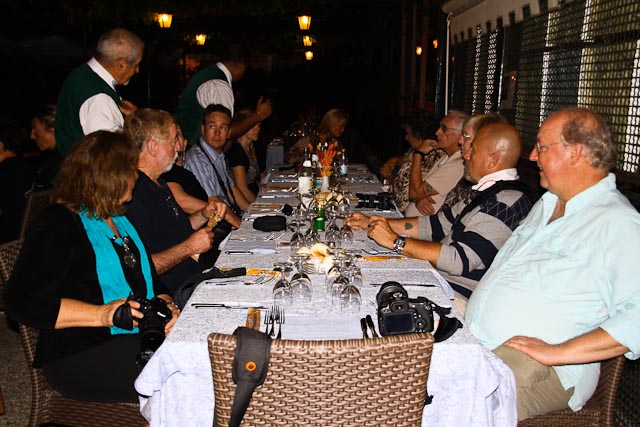
Later, we managed to circumvent the barriers and make our way to Al Giardinetto da Severino, where we had our final dinner together. This was such a great workshop, I was so sorry that it had come to an end!

Press Centre

Press Centre
I couldn't resist this one!