Showing posts with label Greece. Show all posts

5/04/2013

Our Last Day in Chania, Crete, with ARIT


The charming Chania lighthouse, built of stone blocks

On our last morning with Joanna, our Greek guide, we walked to Chania's archaeological museum. The museum is housed in the Venetian curch of St Francis, which once belonged to the Franciscan monks.


On the way, we passed an old Ottoman mosque, the Yiali Tzami, 
right on the edge of the harbour.

There is no minaret, as this was demolished in the early 20th century. The mosque was dedicated to Küçük Hassan Pasha, the first Ottoman military governor of Chania, and  was the first mosque built in Crete after the Ottoman conquest of the city in 1649.


This, the Firkas Fortress, was the headquarters of the Military Commander 
of the city in Ottoman times. 

Built by the Ottomans in 1629, the fortress was used to protect the Sea of Crete from pirates. A chain was stretched from the "Firka" to the lighthouse, at the entrance to the port, to help prevent attacks.


The Lefka Ori (“White Mountains”) form a backdrop to the City of Chania


As we walked to the museum, we couldn't help but notice the graffiti everywhere. 

Joanna, our Greek guide, said that it had proliferated as a form of protest against the EU cuts. Words were lost on us, as we couldn't understand the Greek, but some were more visually graphic...


...as in this one. This appeared to be a stencil that someone had made, 
as I noticed the same one in several places.


Here, Joanna is telling us about this Roman mosaic, showing scenes from the Dionysiac cycle, 
and the myth of Poseidon and the nymph Amymone. 

The museum was small, but nonetheless fascinating, with its chronologically arranged artifacts from the city's history. We saw pottery, carved stone objects, seal stones, sculpture, metalwork, gold jewellery and coins. The seal stones are particularly fascinating, as everyone had a unique seal, that was never replicated, even after the owner had passed on. The seals are intricately carved, with very fine detail, an example of exquisite craftsmanship.

From the museum, we walked back to the hotel to catch our bus to the airport.


On the way, we passed the marble fountain in Plateia Venizelou, Chania
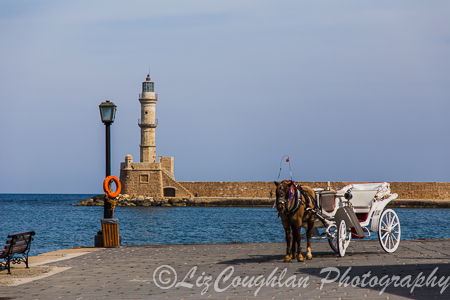


We were delighted to see this horse and carriage at the port. 
It reminded us of the Princes Islands and home.

This was a short trip, and so packed with information, that is was difficult to digest everything at once. Fortunately, I have the Blue Guide to Crete, to read at my leisure. Crete is a fascinating island, and one I would like to return to one day.

4/30/2013

We visit Rethymnon and Knossos, Crete


The restored north entrance to Knossos Palace, with the charging bull fresco.

On our second day, we went to Knossos, which has the distinction of being the earliest inhabited site in Crete; the first settlers having arrived some time before 7000 BC. First excavated by Minos Kalokairinos in 1878, the major excavations at Knossos were carried out by Arthur Evans, a Victorian amateur archaeologist.


Dolphins were revered by the ancient Greeks and Romans. These were originally 
a floor covering, which was later hung on the wall when restored.


This, the "royal road", is one of the oldest and best preserved ancient roads in Europe.


Here,we are listening to Çiğdem transporting us back in time!

From Knossos, we were whisked off to the tiny village of Fodele, where the museum of Domenikos Theotokopoulos (1541 – 1614), otherwise known as El Greco, is hidden away at the end of a long lane. The tiny stone cottage which houses the museum lays claim to being the birthplace of El Greco, although there is some doubt about this.


This room in the museum looks as if El Greco has just stepped outside for a moment!


We wondered whether Black Adder got his inspiration from El Greco!

Lunch was calling, but we still had visits to make, so we headed for Rethymnon, our next port of call. Looming over the town is Fortezza, the Venetian fortress of Rethymnon.


Within the Fortezza is the Fortezza mosque, with its impressive dome. Originally built by the Venetians in the 16th century as the Catholic Cathedral of St Nicholas,  it was converted into the Ottoman Mosque of the Sultan Ibrahim Han, following the fall of Rethymnon to the Turks. Today, it is used as a concert hall as the acoustics are amazing!


Here we are inside the Fortezza Mosque


The richly decorated Rimondi fountain, is situated at Platanos square, the centre of the Venetian town. It was built in 1626, by A.Rimondi, in order to provide the citizens with drinkable water.


Finally, it was time for lunch in a delightful, waterside restaurant, where the waiter serenaded us!


Lunch over, we wandered through the old town of Rethymnon. Unlike Heraklion, this is an attractive town, with evidence of Ottoman and Renaissance-style Venetian architecture.


 Evidence of Rethymnon's Ottoman past


We saw many fine old Ottoman buildings in Rethymnon

When we got to our hotel in Rethymnon, I followed the porter to my room along a long corridor. At the end, I could only see houses through the window. I had resigned myself to a room at the back, until I opened the curtains in my room, and saw this...


Wow! What a view!

4/27/2013

Heraklion, Crete


The Venetian fortress of Rocca al Mare (1523–1540), Heraklion.

Friends of the American Research Institute in Turkey (FARIT) organised a tour to Crete, "focusing on the glories of the Minoan civilisation, while not neglecting the atmospheric remains of the island's Byzantine, Venetian and Ottoman past.". How could I resist such a tantalising trip, especially as we would be accompanied by Dr Çiĝdem Maner, Professor of Archaeology at Koç University?

Our first stop was Heraklion, a rather ugly city at first glance. Centuries of earthquakes, and severe bomb damage in  WWII, has resulted in concrete block houses sprawling around the historic harbour. During our trip, we learned to ignore the  badly designed buildings, adorned with graffiti, and look back to Crete's ancient past.

Our guides, Joanna Kalypso Glyptis, and Dr Çiĝdem Maner, were both archaeologists with such enthusiasm for their subjects, that we were transported back in time, to earlier, powerful civilisations.


Joanna explaining the provenance of some of the artifacts

We began our tour with a visit to the Archaeological Museum of Crete. Unfortunately, it is undergoing restoration at this time, so we only  managed to see a small part of the 15,000 exhibits the museum owns. Incidentally, Joanna told us that the museum is struggling to stay open, as their EU masters have declared that the number of public servants must be drastically cut, so they do not have enough curators, or museum staff, to keep the museum functioning properly.


Kamares vases found in Phaistos and Knossos

The museum's exhibits date from the beginning of the Minoan civilisation (3200/3000 BC) - It is an extraordinary glimpse into the life of a people who lived 5,000 years ago!


Bull leaping is depicted in this well-known wall painting from Knossos 
(Final Palatial period (1450-1400 BC)


This beautiful sarcophagus is dated 1300 BC, and shows offerings being made, 
possibly to the dead man himself.

From the museum, we drove to Malia, the archeological site that is, not to be confused with Malia, the party town of Crete. The ruins at Malia, show the existence of an elite group, judging from the palatial size of the structures. Evidence has also been found of metalworking and a textile industry. Unlike Norman Evans, the discoverer of many sites in ancient Crete, today's archaeologists do not jump to conclusions about the purposes of buildings and artifacts. Evans was a man of his time, a Victorian gentleman, who tended to make suppositions based on his own experiences of life. Now, archeologists are more cautious and less speculative of what might or might not have been, relying primarily on actual evidence.


 A pot found among the ruins in Protopalacial Malia (1900-1700 BC)


These enormous blocks in Malia are evidence of a huge structure


Joanna describes the lay-out of the site

By now we were more than ready for lunch, so were delighted to be driven to a seaside restaurant, where we ate more than our fill, before departing on foot on a guided tour of Heraklion itself.


Naturally, one of the dishes was Greek Salad!


The Church of Titus, the Apostle, in Heraklion


Fontana Morosini, the ornate Venetian fountain in Heraklion

Finally, back at the hotel, it was dinner time, yet more food. I must confess, I ate very little, being still full from lunch. Those Greek meals were enormous, with dish after dish coming to the table in a steady stream. After which, I fell into bed after an exhausting, but fascinating day!

Press Centre

Press Centre
I couldn't resist this one!