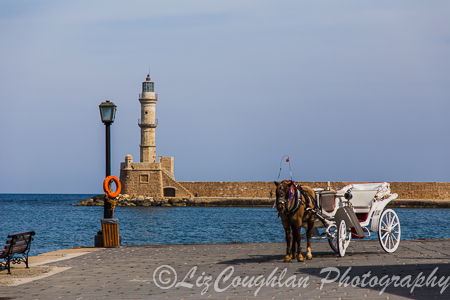
The charming Chania lighthouse, built of stone blocks
On our last morning with Joanna, our Greek guide, we walked to Chania's archaeological museum. The museum is housed in the Venetian curch of St Francis, which once belonged to the Franciscan monks.
On the way, we passed an old Ottoman mosque, the Yiali Tzami,
right on the edge of the harbour.
There is no minaret, as this was demolished in the early 20th century. The mosque was dedicated to Küçük Hassan Pasha, the first Ottoman military governor of Chania, and was the first mosque built in Crete after the Ottoman conquest of the city in 1649.
This, the Firkas Fortress, was the headquarters of the Military Commander
of the city in Ottoman times.
Built by the Ottomans in 1629, the fortress was used to protect the Sea of Crete from pirates. A chain was stretched from the "Firka" to the lighthouse, at the entrance to the port, to help prevent attacks.
The Lefka Ori (“White Mountains”) form a backdrop to the City of Chania
As we walked to the museum, we couldn't help but notice the graffiti everywhere.
Joanna, our Greek guide, said that it had proliferated as a form of protest against the EU cuts. Words were lost on us, as we couldn't understand the Greek, but some were more visually graphic...
...as in this one. This appeared to be a stencil that someone had made,
as I noticed the same one in several places.
Here, Joanna is telling us about this Roman mosaic, showing scenes from the Dionysiac cycle,
and the myth of Poseidon and the nymph Amymone.
The museum was small, but nonetheless fascinating, with its chronologically arranged artifacts from the city's history. We saw pottery, carved stone objects, seal stones, sculpture, metalwork, gold jewellery and coins. The seal stones are particularly fascinating, as everyone had a unique seal, that was never replicated, even after the owner had passed on. The seals are intricately carved, with very fine detail, an example of exquisite craftsmanship.
From the museum, we walked back to the hotel to catch our bus to the airport.
On the way, we passed the marble fountain in Plateia Venizelou, Chania
We were delighted to see this horse and carriage at the port.
It reminded us of the Princes Islands and home.
This was a short trip, and so packed with information, that is was difficult to digest everything at once. Fortunately, I have the Blue Guide to Crete, to read at my leisure. Crete is a fascinating island, and one I would like to return to one day.